Oct_Blog 4_04

How Long Does Window Tint Installation Take and What Happens After?

Once you have finally decided to get your windows tinted, the next questions are usually highly practical ones. How long will this installation actually take? What do I need to do differently with my car afterward? Both of these questions have straightforward answers, but the specific details truly matter. Rushing the process or skipping the professional aftercare guidance can seriously affect how the finished tint looks and performs over time.

Whether you are looking for automotive upgrades or exploring residential window tinting, understanding the timeline is crucial. At Summer Breeze Ceramic Coating & Mobile Detailing, we want our clients to know exactly what happens behind the scenes. Here is a complete guide to understanding the window tint installation timeline and the critical aftercare process required to protect your investment.

How Long Installation Actually Takes

Installation time depends mainly on how many windows are being tinted and the exact body style of your vehicle. A typical passenger car getting all windows tinted (which usually includes the front doors, rear doors, and the rear back glass) is a same-day service in most professional shops. However, the exact appointment length varies significantly by the installer, the complexity of the vehicle glass, and whether any old tint needs to be removed first.

Removing existing tint is a completely separate step that adds a considerable amount of time to the process. This is especially true for older film that has started to bubble, turn purple, or peel away from the edges. If even a microscopic amount of old glue remains on the glass, it will show up under the new tint.

Because appointment length varies by shop, vehicle dimensions, and the total scope of work, the most accurate estimate for your specific vehicle is one you get directly from the installer when booking. There is no single magic number that applies to every car and every shop, so planning for a half-day or full-day drop-off is generally the safest approach.

What Happens During Installation

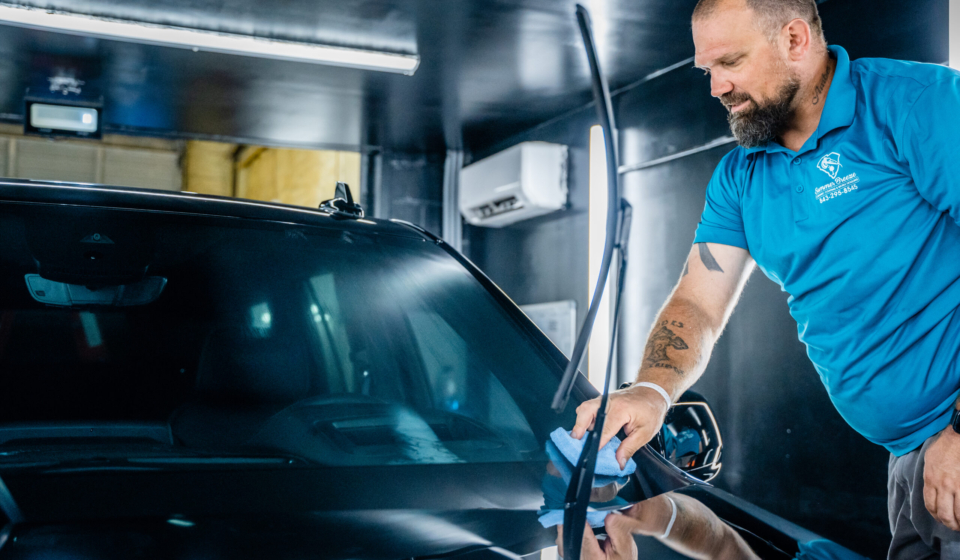
At a high level, professional tint installation follows a highly consistent and meticulous process regardless of the shop you visit. The detailing team at Summer Breeze Ceramic Coating & Mobile Detailing follows these strict procedures to ensure flawless results:

Cleaning the Glass

Every single window being tinted is thoroughly cleaned multiple times. This is not a simple wipe-down with standard glass cleaner. The glass is scrubbed and prepped to remove dust, natural oils, residue, and any microscopic debris. Anything left on the glass can become trapped under the new film and create a permanent visible flaw. We meticulously clean the edges and the weather stripping where dirt loves to hide.

Cutting the Film

The tint film is precisely cut to match the exact shape of each window. Professional shops use either a pre-programmed computer plotter for your specific vehicle make and model or a highly skilled hand-cut method against the exterior of the glass. Both methods require intense precision to ensure the film reaches all the way to the edges without overlapping the seals.

Heat Shrinking

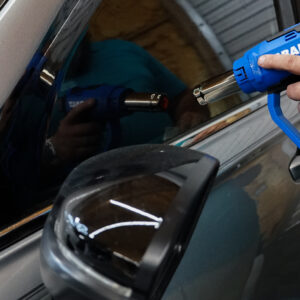
Automotive glass is rarely perfectly flat. The rear windshield, in particular, has a complex curve. Before the film is installed on the inside, it is placed on the outside of the glass and gently heated with a heat gun. This shrinks the film to match the exact curvature of the window, preventing fingers and creases from forming once it is installed on the inside.

Applying the Film

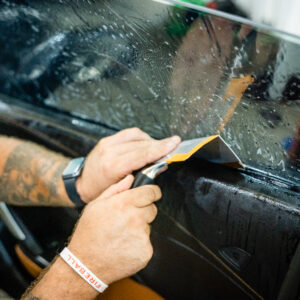
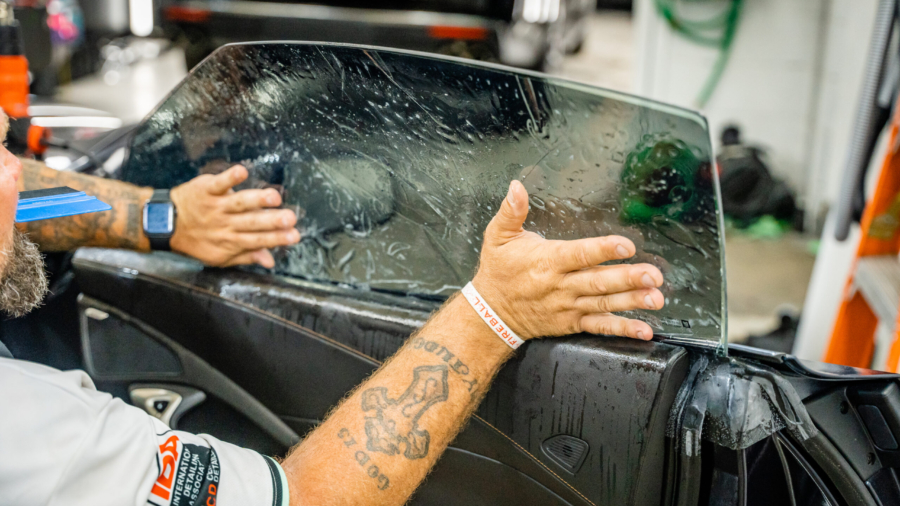
The film is applied to the interior side of the glass using a specialized application solution. This slip solution allows the installer to position the film correctly before it is locked into place. Once the positioning is perfect, the installer uses professional squeegees to firmly push out the air bubbles and excess liquid from behind the film.

Final Inspection

A good installer checks every single window in strong, direct light. They look for leftover moisture pockets, lifted edges, or trapped debris before considering the job complete. The edges are wiped down, and the vehicle interior is carefully cleaned of any remaining application fluid.

Why New Tint Looks Slightly Hazy or Cloudy at First

This is easily one of the most common questions customers ask right after installation, and it is completely normal. Freshly installed tint often has a light haze or a scattering of tiny visible water droplets trapped between the film and the glass. This is simply residual water from the application solution that has not fully evaporated yet. It is not a defect in the film or a sign of poor installation.

Modern ceramic window films are slightly porous. As the film cures over the following days, this trapped moisture gradually evaporates through microscopic channels in the adhesive. The hazy or cloudy appearance will clear entirely on its own, leaving behind a perfectly transparent and sharp view.

The Curing Period: What to Expect

Curing time varies significantly depending on the specific film type, current weather conditions, and how the vehicle is stored. Therefore, there is no single universal number of days that applies to every installation. Your installer can give you a highly specific timeline based on the premium film used on your vehicle. During this general curing window, a few consistent guidelines apply across all types of automotive tint:

  • Avoid rolling down tinted windows. Rolling the glass down before the film has fully cured can physically lift or shift the edges before the adhesive has permanently set. This will cause peeling that cannot be easily fixed.
  • Avoid washing the inside glass. Water, heavy pressure, and cleaning chemicals can severely interfere with the curing process. Plain water rinses on the exterior body of the car are generally fine, but you must avoid direct contact with the interior tinted glass itself.
  • Small moisture bubbles are normal. Tiny bubbles that appear to shrink or disappear over the following days are typically just trapped moisture working its way out of the film. They are not a flaw in the product.
  • Large bubbles are a concern. Persistent large air bubbles or noticeably lifting edges after the full curing period is complete are not normal. If this happens, it is always worth having the installer take a second look.

Curing Time and the Lowcountry Climate

Weather and climate play a very real and measurable role in how the curing process works. Heat generally speeds up evaporation, so warmer weather can shorten the curing window somewhat. Conversely, cool and highly humid conditions can slow the process down.

The climate in Beaufort, Bluffton, and Hilton Head Island runs warm and humid for much of the year. This unique coastal weather cuts in two directions. The warmth helps the trapped moisture evaporate faster, but the high humidity in the South Carolina air can partially offset that by slowing how quickly the moisture escapes from the film.

In practice, this means curing time can vary noticeably by season in the Lowcountry. This is another major reason to get a specific timeline from your installer rather than relying on a generic number found online. What applies to an installation done in a dry, desert climate is absolutely not the same as what applies here on the coast.

Getting Ready for Your Appointment

A little bit of preparation at home makes your appointment day much smoother for both you and the installation team:

  • Clear the interior. Remove anything blocking window access, including window-mounted accessories, dash cams, toll transponders, or aftermarket parking sensors located near the glass.
  • Remove child seats. If you are having the rear windows tinted, removing bulky car seats beforehand gives the installer the physical space needed to maneuver the film without risking damage.
  • Plan your transportation. Expect to be without the car for the entire appointment window your installer quotes. Assuming you can wait in the lobby for a quick turnaround is risky, especially for a full vehicle installation.
  • Review your schedule. Ask about the specific film being used and its expected curing time so you can plan your week around it. A family beach trip where you want to roll the windows down, or a week of frequent car washing, is worth scheduling around the curing period, not through it.
  • Check the follow-up policy. Confirm whether the shop offers any follow-up inspection after the curing period in case a bubble or edge needs a second look once everything has fully set.

Cleaning Tinted Windows Once Cured

After the film has fully cured, cleaning your tinted windows correctly matters just as much as it did during the initial waiting period:

  • Use the right towels. Always use a soft, non-abrasive microfiber towel. You must never use paper towels or anything with a rough texture, which can permanently scratch the surface of the premium film.
  • Avoid ammonia products. Always use an ammonia-free glass cleaner. Ammonia is a very common ingredient in standard household glass cleaners (like Windex), and it will chemically degrade the tint film adhesive and outer scratch-resistant coating over time.
  • Use gentle motions. Clean the glass with light pressure in straight lines rather than aggressive circular scrubbing. This is especially important near the top edges where the film is the most vulnerable to lifting if caught by a towel.

Full Job vs. Partial Job: What Changes

Not every appointment covers the exact same scope. The scope of work directly affects both the installation time and what you should expect afterward:

Scope of Work Relative Time Important Notes
All windows, new film only Baseline This is the most common full-vehicle appointment.
All windows, with old tint removal first Longer than baseline Adhesive residue removal adds meaningful time and labor to the process.
Rear windows and back window only Shorter than baseline Common for drivers prioritizing rear passenger privacy and heat rejection over front visibility changes.
Windshield strip only Shortest This involves the smallest surface area and a single piece of film placed at the top of the windshield.

Whatever the specific scope of your appointment entails, the exact same core curing guidance applies to every single window that is freshly tinted, regardless of how many others were completed at the same time.

Setting Realistic Expectations Before You Book

Going into the process with accurate and realistic expectations makes the whole car window tinting experience much smoother. Plan for the appointment to take the better part of a day for a full vehicle, especially if old tint needs to come off first. Expect some visual haze immediately after pickup, as that is perfectly normal and not a quality issue.

Furthermore, you must plan your personal schedule around a curing period during which you will not be rolling windows down or washing the interior glass. Always ask your installer directly about their internal process for defects noticed after the appointment, so you know exactly what to expect if anything requires a quick follow-up visit.

Preparing for the Road Ahead

Getting your windows tinted is a straightforward process when handled by professionals. Knowing exactly what to expect, from the realistic time commitment and the normal haze right after pickup, to the strict rules during the curing period, makes the experience much less confusing than going in blind. If you are ready to schedule a service or still have specific questions about the installation process for your vehicle, reach out to the experts at Summer Breeze Ceramic Coating & Mobile Detailing. We are here to provide clear, honest answers before your vehicle ever enters our bay.

Frequently Asked Questions

How long does it take to tint all the windows on a car?

For most standard passenger vehicles, a full set of windows is typically a same-day appointment. However, the exact timing depends heavily on the vehicle size, whether old tint needs professional removal, and the specific shop internal process. Always ask your installer for an estimate specific to your vehicle.

Why does my new tint look cloudy or hazy?

This is completely normal and expected. It is simply trapped moisture from the liquid application solution that has not fully evaporated yet. This hazy appearance typically clears up entirely on its own as the film cures over the following days.

Can I roll my windows down right after getting them tinted?

No. You should absolutely avoid rolling any tinted windows down until the film has fully cured. Doing so too early can lift, peel, or shift the edges of the film before the adhesive permanently sets. Ask your installer for the specific timeline for your exact film brand.

When can I wash my car after getting window tint?

You must avoid direct contact with the interior tinted glass, including water, physical pressure, or cleaning chemicals, until the full curing process is complete. Your installer will tell you the specific waiting period for your film. Washing the exterior paint of the car is generally safe.

What should I clean my tinted windows with once they have cured?

Always use a soft microfiber cloth and a dedicated ammonia-free glass cleaner. Standard ammonia-based glass cleaners will aggressively degrade the tint film adhesive and outer protective coating over time, causing premature failure.
Oct_Blog 3_01

Is Window Tint Legal in South Carolina? What Beaufort Drivers Should Know

If you are researching window tint before booking an appointment, asking if the modification is even legal is usually one of the first questions on your mind. This is a highly reasonable concern. Tint laws exist in every state, they are strictly enforced, and getting pulled over for illegal tint is a genuinely common experience for drivers who did not realize their film was too dark. For residents driving through Beaufort, Bluffton, and Hilton Head Island, understanding the local regulations is the best way to avoid unnecessary fines. Here is how you should think about legality before you commit to a specific shade for your vehicle.

Yes, South Carolina Regulates Window Tint Darkness

South Carolina, like all states, has specific rules governing how dark a vehicle window tint can legally be. These rules are typically expressed as a minimum VLT percentage. VLT stands for Visible Light Transmission, which is essentially the measurement of how much ambient light is allowed to pass through the tinted window and into the cabin. These requirements usually vary by window position. The windshield, front side windows, back side windows, and rear window are often treated differently under the law, with front windows generally held to a lighter and more transparent standard than rear windows.

Currently, South Carolina law requires that the front side windows, rear side windows, and the back windshield must all allow at least 27 percent of light to pass through. For the front windshield, drivers are only permitted to have a non-reflective tint strip applied along the top edge down to the AS-1 line provided by the manufacturer. Additionally, South Carolina requires that your tint must not be red, yellow, or amber in color. A compliance sticker from a professional installer is also required to be placed between the film and the glass on the lower right corner of the driver side window.

Rather than guessing or relying on outdated internet forums, the most reliable path is to confirm current requirements directly with a licensed tint installer at the time you are getting work done. This is exactly the kind of question the professional team at Summer Breeze Ceramic Coating & Mobile Detailing is equipped to answer accurately for your specific vehicle and driving needs.

Why This Matters More Than It Might Seem

Illegal tint is not just a theoretical risk. It is one of the more common reasons drivers get pulled over by local law enforcement or highway patrol. A traffic stop for illegal tint can result in a citation, a formal requirement to have the tint removed, or both, depending on the severity of the violation and how it is handled locally in the Lowcountry.

Beyond the legal exposure and potential financial penalties, tint that is too dark for legal driving conditions can also raise practical safety concerns. Nighttime visibility is absolutely critical when navigating the unlit backroads of Beaufort and the surrounding coastal communities. If your windows are overly dark, spotting pedestrians, wildlife, or debris on the road at night becomes incredibly difficult. This is a significant issue for South Carolina drivers simply because it is an active, enforced part of the vehicle code rather than a rule that exists only on paper.

How Restrictions Generally Differ by Window Position

Most states, including South Carolina, do not apply one single tint rule to the whole vehicle. Instead, different windows are typically held to different standards to balance passenger comfort with overall road safety. Here is a look at the general pattern for vehicle window tinting:

Window Position Typical Relative Strictness General Reasoning
Windshield Most restrictive Direct forward visibility is considered absolutely critical for safe driving at all hours.
Front side windows More restrictive than rear Police officers and other drivers often need a clear view into the front seat for safety and communication.
Back side windows Generally more permissive There is a reduced visibility concern relative to the front windows, allowing for more privacy for rear passengers.
Rear window Generally most permissive Vehicles with heavy rear tint frequently must be equipped with functioning dual exterior side mirrors to compensate.

This table describes the general shape of how states commonly structure tint law. As mentioned above, South Carolina specifically enforces the 27 percent VLT rule for side and rear windows. Those specifics are always confirmed during your consultation at Summer Breeze Ceramic Coating & Mobile Detailing.

Common Misunderstandings About Tint Law

There is a lot of misinformation circulating about window tinting regulations. Believing these myths can easily lead to a citation. Here are the most common misunderstandings we see among vehicle owners:

  • If it is legal somewhere, it is legal everywhere. Tint law varies significantly by state. Film that is completely compliant in one state can be highly illegal in another. This matters greatly if you bought a vehicle out of state or had tint installed elsewhere before moving to a military town like Beaufort, South Carolina.
  • Darker tint installed by a professional is automatically legal. A reputable, professional installer should be knowledgeable about current state requirements and will typically discuss legal shade options with you. However, some shops will install excessively dark tint if a customer insists on it for a show car. The ultimate compliance of the finished vehicle on public roads is your responsibility.
  • The windshield can be tinted as dark as the windows. Windshields are almost universally treated differently and much more restrictively than side or rear windows under state tint laws. South Carolina limits front windshield tint to a non-reflective strip along the top rather than full glass coverage.
  • Tint law only applies to aftermarket tint. Some state rules apply to any window tint, whether factory-installed, dealer-applied, or aftermarket. You should never assume factory tint is automatically exempt without checking the combined VLT percentage.

What a Professional Installer Should Be Able to Tell You

Before choosing a shade, a knowledgeable tint installer should be able to walk you through a comprehensive consultation. The team at Summer Breeze Ceramic Coating & Mobile Detailing ensures you understand the following points before any film touches your glass:

  1. Which specific window positions have different legal requirements on your exact vehicle make and model.
  2. How your desired visual look compares to what is currently allowed by South Carolina highway patrol.
  3. Whether any medical exemption process exists in South Carolina and what that process generally requires. A professional shop will guide you on the DMV paperwork without falsely promising to guarantee approval, since that decision is determined exclusively by the state.
  4. What happens if your vehicle existing tint is found to be non-compliant. We can walk you through safe removal, retinting, or required documentation depending on the situation.

If a shop cannot or will not answer these questions with total confidence, that is worth treating as a serious red flag before you commit your hard-earned money.

Legal Tint Does Not Mean Low-Quality Tint

One misconception worth addressing directly is the idea that legal film is ineffective. Choosing a legally compliant shade does not mean settling for a weaker product or giving up on heat and UV protection. Most of the practical benefits of window tint come from the actual film technology and quality, not primarily from how dark it looks to the human eye.

Modern nano-ceramic films, such as the Owner’s Pride, Apeax, and Union Window Films installed by Summer Breeze Ceramic Coating & Mobile Detailing, are engineered to block massive amounts of infrared heat and UV rays without needing to be pitch black. A well-chosen, legal shade in a high-performance ceramic film will absolutely outperform an illegally dark, lower-quality dyed film on nearly every functional measure.
The only thing a dark dyed film offers is a dark look from the outside. If your goal is surviving the brutal South Carolina summer heat, premium ceramic technology is the answer. We cover how to think through shade and film choice together in much more detail in our blogs.

How Enforcement Typically Works on the Road

Tint is one of the easiest vehicle-code items for law enforcement to observe in real time. Officers commonly carry handheld tint meters that measure the exact VLT percentage directly at a traffic stop. The officer simply slides the small device over your rolled-down window, and it instantly reads the amount of light passing through.

This objective measurement is part of why tint violations are so frequently cited on their own, completely without any other traffic issue involved. The darkness is visually obvious, and the measurement is exceptionally quick to take. If a traffic stop results in a tint citation, the outcome typically depends on local practice and how far outside the legal range the film measures. This can range from a friendly warning to a costly citation requiring immediate correction and a court appearance.

Keeping Documentation After Installation

Regardless of where you have your premium tint installed, it is always worth asking for and keeping physical documentation of the work. You should retain an invoice or receipt that clearly specifies the film brand used, the VLT percentage applied, and the professional shop that installed it.

While South Carolina requires the physical compliance sticker between the film and the glass, keeping your receipt in the glovebox is a genuinely useful practice. If your vehicle is ever stopped and questioned by an officer about tint darkness, being able to show professional documentation of what was installed and by whom can simplify the conversation considerably compared to having no record at all.

What Happens If Existing Tint Is Not Compliant

If you have purchased a pre-owned vehicle with tint already installed from a previous owner, a local dealership, or an out-of-state seller, you might not be sure whether it is fully compliant. That is an issue worth having checked before it becomes a problem on the road.

A professional shop like Summer Breeze Ceramic Coating & Mobile Detailing can safely assess your existing film using a tint meter. We can advise whether it meets current South Carolina requirements and walk you through your best options if it does not. Having a professional safely steam and remove illegal tint is much less stressful than being forced to scrape it off yourself in a driveway after receiving a fix-it ticket.

Navigating Your Next Steps for Tint Installation

Window tint law in South Carolina is very real, actively enforced, and highly worth understanding before you choose a shade rather than finding out after the fact. The specific percentage thresholds are best confirmed directly with a knowledgeable local installer at the time of your appointment, since exact figures and enforcement practices can shift over time.

What absolutely does not change is the value of working with a shop that treats legal compliance as a core part of the job, not an afterthought. If you are weighing your options for heat rejection, privacy, and UV protection, reach out to Summer Breeze Ceramic Coating & Mobile Detailing. We are ready to talk through what is right, effective, and completely legal for your vehicle in the Lowcountry.

Frequently Asked Questions

Can I get a ticket for illegal window tint in South Carolina?

Yes. Tint darkness that does not meet the state legal requirement of 27 percent VLT can result in a traffic citation. It may also require the illegal tint to be physically removed or corrected, depending on the specific situation and how the officer handles the stop.

Is the windshield allowed to be tinted as dark as the side windows?

Generally no. Windshields are typically subject to far more restrictive rules than side or rear windows. South Carolina limits windshield tinting to a non-reflective strip along the top AS-1 line rather than full glass coverage. Always confirm these specifics with your trusted installer.

Does professional installation guarantee my tint is legal?

A knowledgeable, professional installer should be well-informed about current requirements and should actively discuss legal options with you. However, it is still worth confirming compliance directly, especially if you are specifically requesting an exceptionally dark shade for aesthetic reasons.

Can I be pulled over just for tint that looks dark?

Yes. Window tint is a highly visible, easily observed vehicle-code item. It is a very common reason for a primary traffic stop entirely independent of any other driving violation like speeding or running a red light.

Does legal tint still block UV rays and heat effectively?

Yes. Most of the functional performance of window tint comes from the film quality and technology, not primarily from how dark it appears. Features like UV protection, heat rejection, and glare reduction are outstanding in premium ceramic films. A properly chosen legal shade from Owner’s Pride or Apeax can perform incredibly well on all these measures without breaking the law.

Oct_Blog 2_02

How to Wash a Ceramic-Coated Car the Right Way

A ceramic coating is built to last years rather than months, but that durability depends partly on how the car is washed afterward. The coating itself does not need much help to keep protecting your paint, but the wrong wash routine can dull its gloss, shorten how well it performs, or undo some of what you paid for. The good news is that washing a coated car correctly is not complicated. It just follows a different set of habits than washing an uncoated car.

Before Your First Wash

If your coating was recently applied by Summer Breeze Ceramic Coating & Mobile Detailing, do not wash the car until it has fully cured. Washing too early, especially with anything other than plain water, can interfere with the curing process of premium products like Owner’s Pride. We cover the specific cure timeline in detail in our guide on how long ceramic coating takes to cure. Once that curing window has passed, the guidance below applies for the life of the coating.
Skip the Automatic Car Wash

This is the single most common mistake coated-car owners make. Automatic tunnel washes, especially ones with brushes rather than touchless systems, use abrasive contact and often harsh, high-pH detergents designed to strip road grime fast. That combination can introduce fine scratches (swirl marks) into the coating surface and gradually degrade its hydrophobic performance. Touchless automatic washes are less risky than brush washes but still typically use stronger chemical detergents than hand washing does. For a coated vehicle, a careful hand wash is almost always the better choice.

Comparing Your Wash Options

Wash Method Risk to Coating Typical Chemical Strength Best For
Hand wash, two-bucket method Lowest Adjustable (use pH-neutral soap) Coated vehicles, long-term care
Touchless automatic wash Moderate Often high-alkaline detergents Occasional convenience washes between hand washes
Brush/friction automatic wash Highest Often high-alkaline detergents Not recommended for coated vehicles
Rinseless wash (spray-and-wipe) Low, if done correctly Adjustable (use a coating-safe rinseless product) Quick maintenance washes, water-restricted areas

This is general guidance based on how each method physically interacts with a coated surface. Actual results vary by the specific equipment and chemicals a given wash location uses.

Use the Two-Bucket Method

Hand washing correctly matters as much as hand washing at all. The two-bucket method (one bucket with soapy water, one with plain rinse water) is the standard approach professional detailers recommend for any vehicle, coated or not, and it matters even more on a coating you want to protect long-term:

  1. Rinse the entire car first to loosen surface dirt before any contact with a wash mitt.
  2. Dip a clean microfiber wash mitt in the soap bucket, wash one panel, then rinse the mitt in the plain water bucket before dipping it back in the soap.
  3. Work top to bottom, since the lower panels and wheel wells accumulate the most grit.
  4. Rinse the full car again to remove all soap residue.
  5. Dry with a clean, dedicated drying towel or a blower. Never let the vehicle air-dry, which can leave stubborn water spots.

The rinse-between-dips step is what keeps grit picked up from the car off your wash mitt, which is what actually causes swirl marks. The washing itself is not the problem; the trapped dirt is.

Choose the Right Soap

Not every car soap is coating-safe. Look for a pH-neutral formula rather than a high-alkaline “wax-stripping” or “tar and bug” soap. Those stronger chemicals are designed specifically to break down protective layers, which is exactly what you do not want on a coated surface. A pH-neutral soap cleans effectively without chemically attacking the ceramic coating itself.

Skip Anything Marketed as a “Ceramic Boost” You Do Not Need

A wide range of spray-on “ceramic boost” or “coating enhancer” products are marketed to coated-car owners. Whether any given product is worth adding on top of a properly applied professional coating depends on the specific coating and the product in question. This is a decision worth discussing directly with the detailing experts at Summer Breeze Ceramic Coating & Mobile Detailing rather than assuming every add-on is necessary or beneficial for your vehicle.

How Often Should You Wash a Coated Car?

There is no single fixed schedule that fits every situation. How often you should wash depends on how the car is used and stored. A vehicle parked outdoors near the coast, exposed to salt air, pollen, and bird droppings, will need more frequent washing than a garage-kept car driven occasionally. As a general guideline, most detailers recommend washing every one to two weeks for a daily driver. You should rinse the vehicle sooner after exposure to anything acidic (like bird droppings, tree sap, or bug splatter) because those contaminants can etch a finish, coated or not, the longer they sit.

Washing a Coated Car in a Coastal Climate

Cars parked or driven near the coast (Beaufort, Bluffton, Hilton Head Island, Port Royal, Lady’s Island, Ridgeland, and Hardeeville all fall into this category) pick up salt residue from the air even without ever touching salt water directly. Salt residue plus humidity is a combination that can accelerate corrosion on exposed metal and, over time, work against any protective layer if it is allowed to sit and build up.

In practice, that means two things for a coated car in this region: rinsing more often than you might in a drier inland climate, and paying closer attention to areas that trap moisture and grit, like wheel wells, lower rocker panels, and door jambs.The same environmental factors apply directly to your wash frequency and technique.

Watch for These Warning Signs

  • Water stops beading tightly. This is the clearest sign the coating hydrophobic performance is fading, whether from age, wear, or improper washing.
  • The surface feels rough after washing. This can mean contaminants are bonding to the coating rather than sheeting off, which sometimes calls for a clay bar treatment or a professional decontamination wash.
  • New swirl marks appear in direct sunlight. This usually points back to wash technique, most often a dirty wash mitt, a brush automatic wash, or drying with the wrong towel.

If you notice any of these issues and are not sure what is causing it, that is a good time to bring the car back to Summer Breeze Ceramic Coating & Mobile Detailing for a professional inspection rather than guessing at a fix.

A Few Things to Avoid Entirely

  • Dish soap. It is formulated to strip oil and grease and will strip a coating protective properties along with it.
  • Drying with a regular bath towel. Standard towels are far more likely to introduce fine scratches than a proper microfiber drying towel.
  • Waxing over a ceramic coating. It is not harmful, but it is unnecessary. The coating is already doing the job wax is meant to do, and it will not bond the same way to a coated surface.

Quick Reference: A Coating-Safe Wash Routine

  1. Confirm curing is complete before the first wash.
  2. Rinse the full car before touching it with a mitt.
  3. Hand wash using the two-bucket method with a pH-neutral soap.
  4. Rinse thoroughly and dry with a clean microfiber towel or blower.
  5. Rinse promptly after exposure to bird droppings, tree sap, or heavy salt air.
  6. Skip brush-style automatic washes; use touchless only occasionally.
  7. Watch for reduced water beading or a rougher surface as signs it is time for a professional check-up.

Keeping this routine consistent is a bigger factor in how long a coating performs well than any single product added on top of it.

Maintaining Your Coated Vehicle for the Long Haul

A ceramic coating does most of the heavy lifting once it is cured, but it is not maintenance-free. It is maintenance-reduced. The habits above (hand washing, the two-bucket method, pH-neutral soap, and skipping automatic tunnel washes) are what keep a coating performing the way it is designed to for years rather than months. If you are noticing signs your coating is not performing the way it used to, talk to Summer Breeze Ceramic Coating & Mobile Detailing about what is going on with your paint.

Frequently Asked Questions

Can I take my ceramic-coated car through a regular car wash?

Touchless automatic washes are lower-risk than brush-style washes, but a careful hand wash with the two-bucket method is generally the safest option for protecting a coating long-term performance.

How soon can I wash my car after ceramic coating is applied?

This depends on the specific curing timeline for your application. See our guide on [how long ceramic coating takes to cure] for the full timeline before washing for the first time.

What soap should I use on a ceramic-coated car?

Look for a pH-neutral car wash soap. Avoid high-alkaline soaps marketed for stripping wax or removing tar, since those same properties can degrade a coating over time.

Do I need to apply anything on top of my ceramic coating?

Not necessarily. Whether a topper or boost product adds value depends on your specific coating and situation. It is worth asking the detailer who applied your Owner’s Pride coating rather than assuming an add-on is required.

How do I know if my coating needs to be reapplied?

Watch for water no longer beading tightly, a rougher feel after washing, or a noticeably flatter appearance. Any of these can indicate it is time for a professional evaluation.

Oct_Blog 1_02

Ceramic Coating vs. Wax vs. Sealant: What Is Actually Different?

Ceramic coating, wax, and sealant all promise to protect your paint and make it easier to keep clean, but they are not variations of the same product. They are three different approaches, with different lifespans, different levels of protection, and different amounts of upkeep. If you are trying to decide which one makes sense for your car, the differences are worth understanding before you spend money on any of them.

The Short Answer

Wax is the shortest-lived option, typically needing reapplication every few weeks to a couple of months. Paint sealant is a synthetic product that lasts longer than wax, often several months, because it bonds more durably to the clear coat. Ceramic coating is a different category altogether. It is a liquid polymer that chemically bonds to the paint surface and, once cured, is designed to last years rather than months, with far less ongoing maintenance.

None of the three is strictly “better” for every situation. They solve for different budgets, timelines, and expectations. Here is how they actually compare when you evaluate the right service for your vehicle at Summer Breeze Ceramic Coating & Mobile Detailing.

How Each One Protects Your Paint

Wax

Wax sits on top of the clear coat as a thin protective layer, usually made from natural carnauba wax, synthetic polymers, or a blend. It adds gloss and a degree of water beading, and it is the most affordable, most accessible option. Most people can apply it themselves in an afternoon. Its tradeoff is durability. Sun exposure, washing, and daily driving wear it down quickly, which is why detailers generally recommend reapplying it every 4 to 8 weeks.

Paint Sealant

Paint sealant is also a topical product, but it is synthetic rather than natural, which lets it bond more tightly and resist breakdown from UV rays and washing for longer, commonly a few months per application rather than a few weeks. Sealants tend to produce a slightly different look than wax, often described as a “sharper” shine rather than a “warmer” one, and they hold up better under regular use, but they are still sitting on the surface rather than bonding into it.

Ceramic Coating

Ceramic coating works differently at a chemical level. It is applied as a liquid and cures into a hard, glass-like layer that bonds to the paint surface rather than just sitting on it. That bond is what gives it its much longer service life and its stronger resistance to chemical staining, UV fading, and minor environmental etching. Because the coating itself is doing the protective work, cars with a ceramic coating typically need less frequent, less intensive washing to keep looking clean. However, “less maintenance” does not mean “no maintenance,” which is a topic we emphasize when educating clients on washing a coated car correctly.

Side-by-Side: How the Three Compare

Feature Wax Paint Sealant Ceramic Coating
Type of bond Sits on top of the clear coat Sits on top of the clear coat Chemically bonds to the clear coat
Typical reapplication Every few weeks to 2 months Every few months Designed to last years, not months
UV/chemical resistance Lowest of the three Moderate Highest of the three
Upfront cost Lowest Moderate Highest
DIY-friendly Yes, widely Yes, with more care Best suited to professional application and prep
Best fit for Owners who enjoy frequent hands-on maintenance Owners who want more durability without a big upfront cost Owners who want the longest-lasting, lowest-maintenance protection

This table is a general industry comparison, not a description of any specific product line. Actual performance varies by manufacturer, application quality, and how a vehicle is used and stored.

Durability and Maintenance: The Real-World Difference

The gap that matters most to most owners is how often you have to redo the work. Wax needs the most frequent attention of the three. Sealant stretches that out. Ceramic coating stretches it out considerably further, which is a major part of why coating tends to appeal to owners who want long-term, low-maintenance protection rather than a product they reapply as a seasonal ritual.

That said, “low maintenance” is relative, not absolute. A ceramic-coated car still needs to be washed regularly and with the right technique. Using the wrong wash method or harsh chemicals can still dull the finish or shorten how well the coating performs over time, even though the coating itself is bonded rather than topical.

Why This Comparison Matters More in Coastal South Carolina

Beaufort and the surrounding Lowcountry, including Bluffton, Hilton Head Island, Port Royal, Lady’s Island, Ridgeland, and Hardeeville, sit in a climate that is harder on a car finish than most of the country. Salt air, high humidity, and long stretches of direct UV exposure all accelerate the breakdown of topical products like wax and sealant.

At Summer Breeze Ceramic Coating & Mobile Detailing, we know exactly how salt air and humidity affect your car paint. The short version is that whatever protection you choose has to work harder here than it would somewhere drier and further from the coast. That environmental pressure is one of the main reasons coastal vehicle owners often lean toward a longer-lasting, more chemically resistant option rather than a product that needs reapplying every few weeks in a climate that is actively working against it.

Cost and Commitment: What to Actually Weigh

Rather than quoting specific prices, which vary by vehicle condition, prep work needed, and the scope of the job, the more useful way to think about the decision is total cost of ownership over time. Wax is cheap per application but has to be repeated often. Sealant costs more per application but less often. Ceramic coating has the highest upfront investment but is designed to go the longest between reapplications, with professional application at Summer Breeze Ceramic Coating & Mobile Detailing also including paint correction and prep work that wax and sealant typically skip.

If you are unsure which option fits your car, your budget, and how you use the vehicle, that is a conversation worth having directly with a detailer who can look at your paint actual condition, not a decision to make from a chart alone.

Signs Your Current Protection Has Worn Off

Regardless of which of the three you are using now, there are a few common signs that a paint protective layer has worn down and needs attention:

  • Water stops beading: A strong, tight water bead is one of the simplest visual indicators that a protective layer is still active. When water starts sheeting flat across the surface instead of beading up, that is usually a sign the layer has broken down.
  • The paint feels rougher to the touch: Run a clean hand lightly over a washed panel. If it feels gritty rather than smooth, contaminants are bonding directly to the paint rather than being held off by a protective layer.
  • Gloss looks flatter, especially in direct sun: Fading gloss is often more noticeable than fading protection itself, since the two tend to go together.
  • Washing feels harder than it used to: If dirt and grime seem to cling more stubbornly than they did when the protection was freshly applied, that is a practical sign it is time to reassess.

Wax and sealant will show these signs on a predictable schedule, since they are designed to wear down. A properly applied ceramic coating should not show these signs for years, which is part of why coating owners tend to notice a problem faster when something is wrong. The baseline expectation is a much longer stretch of consistent performance.

Which One Is Right for You?

  • If you want the lowest upfront cost and do not mind frequent reapplication, wax is the simplest entry point.
  • If you want more durability than wax without the bigger investment of a coating, sealant is the middle ground.
  • If you want the longest-lasting protection, the strongest resistance to this region salt air and UV exposure, and the least frequent maintenance cycle, a ceramic coating from Summer Breeze Ceramic Coating & Mobile Detailing is built for that use case.

Final Thoughts on Protecting Your Investment

Wax, sealant, and ceramic coating are not competing versions of the same idea. They are three different commitments, with three different payoffs. In a coastal climate like Beaufort, where salt air and humidity put extra strain on a car finish year-round, the gap between a topical product and a bonded coating tends to show up faster than it would inland. If you want to talk through which approach makes sense for your specific vehicle, reach out to Summer Breeze Ceramic Coating & Mobile Detailing to discuss your options.

Frequently Asked Questions

Do I still need to wax my car if it has a ceramic coating? 

No. A ceramic coating is designed to replace wax and sealant as the paint primary protective layer. Adding wax on top is not necessary and will not meaningfully add protection once a coating is properly cured.

Which lasts longer, sealant or ceramic coating? 

Ceramic coating lasts significantly longer than sealant. Sealant is a topical product that typically needs reapplying every few months, while a properly applied and maintained ceramic coating is designed to last years.

Is ceramic coating worth it if I only drive occasionally? 

It can still make sense, since coatings protect against environmental exposure like sun, salt air, and humidity even when a car is parked, not just from road wear. Whether it is worth it for your situation depends on your goals and budget, which is best discussed directly with our detailing team.

Can I apply ceramic coating myself instead of wax? 

Consumer-grade ceramic products exist, but professional-grade coatings generally require proper paint prep and correction beforehand and precise application to bond and cure correctly. Skipping prep work can significantly affect how well any of these products perform.

Does ceramic coating make washing my car unnecessary? 

No. A coating reduces how hard grime bonds to the surface and makes washing easier, but regular washing with the right method is still needed to keep both the paint and the coating performing well over time.

Sep_Blog_04

What Window Tint Actually Does for Your Car’s Interior

Window tint is often discussed in terms of appearance and privacy, but those are not its only purposes. The right automotive film can also help manage UV exposure, solar heat, and glare.

The level of performance depends on the specific film selected. Shade alone does not tell you how much heat or UV radiation a product rejects, so each benefit should be considered separately.

UV Exposure and Interior Fading

Sunlight entering through automotive glass can contribute to the gradual fading and deterioration of upholstery and other interior materials. Window film is one way to reduce the amount of UV radiation entering the cabin.

Summer Breeze states that its automotive window tinting can block up to 99% of UV radiation. The phrase “up to” is important because exact performance may vary by film. Ask the installer for the specifications of the product being considered.

UV protection is preventive. Tint cannot reverse fading or deterioration that has already occurred, but reducing continued exposure can support efforts to maintain the interior’s appearance.

It is also important not to treat tint as a guarantee against all interior wear. Material quality, vehicle age, cleaning products, moisture, physical use, and parking conditions can also affect how an interior ages.

Heat Rejection Changes How the Cabin Feels

A parked vehicle can become uncomfortable after extended exposure to direct sunlight. Automotive film designed for heat rejection can reduce the amount of solar heat entering through the glass and support a more comfortable cabin.

Summer Breeze describes heat rejection and a cooler interior as key benefits of its tint films. The result depends on the selected product, vehicle glass, coverage, weather, and parking conditions.

Tint does not keep a parked vehicle at a safe or constant temperature. It also does not make it safe to leave children, pets, or heat-sensitive belongings inside a parked vehicle. Cabin temperatures can still rise significantly.

After returning to a hot vehicle, normal ventilation and air conditioning may still be necessary. Tint should be viewed as a comfort feature that reduces solar heat transmission, not as a complete solution to heat buildup.

Heat Rejection and Long-Term Interior Care

Reducing solar heat entering through the glass may lessen some of the repeated heat exposure experienced by interior surfaces. However, the amount of long-term protection cannot be predicted from shade alone.

Interior materials vary considerably between vehicles, and many factors contribute to their condition. It would therefore be inaccurate to promise that tint will prevent cracking, adhesive failure, or all forms of heat-related aging.

The most supportable benefit is that an appropriate film can reduce incoming solar heat and UV exposure. These features can form one part of a broader interior-care approach that also includes thoughtful parking, cleaning, and maintenance.

Glare Reduction and Driving Comfort

Summer Breeze lists glare reduction among the benefits of its automotive window films. Reducing glare from sunlight or headlights can make driving more comfortable for many people.

However, glare reduction should be balanced with visibility. A very dark configuration may reduce the amount of visible light entering through the glass, particularly at night or in poor weather.

The appropriate choice depends on the driver, vehicle, window position, selected film, and current legal requirements. Tint is not a substitute for safe driving or clear visibility.

Why Parked Time Matters

A vehicle can receive substantial sunlight while parked, even if it is driven only for short trips. Cars kept in open parking lots or uncovered driveways may spend hours exposed to sun without anyone inside.

This is one reason UV protection and heat rejection can matter even to people who do not have long commutes. The benefit is related to total exposure, not just driving time.

Parking under cover can reduce direct sunlight when practical. Tint provides an additional layer of protection through the glass, but neither measure completely prevents cabin heat or interior aging.

Privacy, Without Overstating It

Window tint can make the cabin less visible from outside, particularly through rear windows and back glass. Many owners value this added privacy and the appearance it creates.

Tint does not make a vehicle secure or prevent theft. Valuables should still be removed or kept out of sight, and the vehicle should always be locked.

Privacy also depends on shade, lighting, viewing angle, and the specific glass. It should be treated as a practical preference rather than an absolute barrier to visibility.

Resale and Long-Term Presentation

Interior condition can influence how a used vehicle is perceived by a buyer or dealer. Faded upholstery, damaged trim, stains, and worn surfaces may affect the overall presentation of the vehicle.

UV-rejecting film can support efforts to preserve interior appearance, but it does not guarantee a particular resale value. Mileage, mechanical condition, service history, market demand, accident history, and many other factors also affect valuation.

Tint is best understood as one preventive measure within a broader vehicle-care routine.

What Tint Doesn’t Do

Window tint can reduce UV transmission, solar heat, and glare, but it has limits.

It does not:

  • Keep a parked cabin at a safe temperature
  • Reverse existing fading or interior damage
  • Prevent all cracking or material wear
  • Guarantee a higher resale price
  • Replace safe visibility or driving judgment
  • Eliminate the need to follow tint laws
  • Make belongings inside the vehicle secure

Setting realistic expectations makes it easier to choose a film based on measurable features rather than exaggerated promises.

Protecting the Whole Vehicle

Tint addresses sunlight and heat entering through automotive glass. Exterior paint faces a different combination of UV exposure, road grime, water spots, bird droppings, and environmental contamination.

Ceramic coating and window tint may be discussed together as parts of whole-vehicle care, but they perform different functions. One does not replace the other.

When Tint Stops Doing Its Job

Automotive window film can age or become damaged over time. Bubbling, peeling, discoloration, edge lifting, or noticeable optical distortion may indicate that the film needs professional inspection.

These symptoms do not prove the exact level of UV or heat-rejection performance remaining, but they are valid reasons to have the installation evaluated. Review the signs your window tint may need replacing if an existing film has begun to change in appearance.

Choosing the Right Film for These Benefits

Not every film provides the same balance of heat rejection, UV protection, glare reduction, shade, clarity, and appearance.

Getting the Benefit for Your Vehicle

Summer Breeze installs Owner’s Pride, Apeax, and Union Window Films. Its website lists heat rejection, up to 99% UV protection, glare reduction, privacy, and professional installation among the benefits available through its automotive tint service.

Visit Summer Breeze’s window tinting service page to review the current film brands and installation options.

FAQs

Does window tint stop dashboard cracking?

Tint can reduce UV exposure and solar heat entering through the glass, but it cannot guarantee that a dashboard will never crack. Material quality, age, temperature, care, and other conditions also affect interior wear.

Is tint useful if I only have a short commute?

It can be. UV and solar heat exposure also occur while the vehicle is parked. The benefit depends on the vehicle’s total exposure, not only the length of each drive.

Does lighter tint still provide UV protection?

It may. UV protection depends on the film’s construction and specifications, not only its visible shade. Ask for the specifications of the exact film being offered.

How soon will I notice the benefits?

Changes in glare or cabin comfort may be noticeable soon after installation. Protection from fading is preventive and cumulative, so it is not a benefit that can be measured immediately from appearance alone.

Sep_Blog_03

How to Choose the Right Window Tint Shade and Film

Choosing automotive window tint often begins with one question: how dark should it be? Shade matters, but it is only one part of a decision that also involves film performance, visibility, coverage, appearance, and legal requirements.

A better starting point is to decide what you want the tint to accomplish and then compare the film options that meet those priorities.

Start With What You’re Trying to Solve

Drivers may choose tint for several reasons.

Heat and comfort. If your main goal is a more comfortable cabin, ask about the film’s heat-rejection performance. A darker appearance does not, by itself, provide enough information to compare how two different films handle solar heat.

Glare reduction. Window tint can reduce distracting glare from sunlight and headlights. The appropriate shade still needs to support adequate visibility, especially for drivers who spend significant time on the road at night.

Privacy and appearance. Darker shades can create a different exterior appearance and may make the cabin less visible from outside. These preferences should be balanced with visibility and legal requirements.

Interior protection. Summer Breeze states that its automotive window tinting can block up to 99% of UV radiation and help protect the vehicle’s interior. Because “up to” represents the highest available performance rather than a guarantee for every film, ask about the specifications of the exact product being considered.

Most drivers care about more than one of these benefits. Identifying the top two priorities gives the installer a clearer basis for recommending a film.

Film Type Matters as Much as Shade

Summer Breeze currently lists Owner’s Pride, Apeax, and Union Window Films among the products it installs. The business describes its Owner’s Pride films as durable and fade-resistant products engineered for heat rejection and UV protection. Its website describes Apeax as using nano-ceramic technology for heat reduction, optical clarity, and appearance. Union Window Films are presented as options for glare reduction, interior protection, and everyday driving comfort.

Don’t Skip the Legal Question

Automotive tint requirements vary by state, window position, and vehicle type. A shade that is permitted on one window or vehicle may not be permitted in another application.

Because regulations can change, this article does not provide a fixed legal percentage. Before selecting a configuration, confirm the current South Carolina requirements with an official state source and discuss them with the installer.

Summer Breeze states that it offers tint shades intended to suit customer preferences while adhering to applicable legal standards. The final decision should still be based on the vehicle, window position, selected product, and current rules.

Practical Considerations Beyond Shade and Film

Which windows are being tinted. Front side windows, rear side windows, back glass, and windshield areas may have different practical and legal considerations. Decide whether you want full coverage or a partial tint package before comparing options.

Visibility at night. Darker film can reduce the amount of visible light entering through the glass. Drivers who frequently travel at night should discuss visibility with the installer before choosing a shade.

Existing automotive glass. Some factory glass already has color, privacy glazing, or other properties that affect how an added film will look and perform. The combined result should be evaluated on the actual vehicle.

Film performance. Ask for product information covering heat rejection, UV protection, clarity, care requirements, and warranty terms. Avoid assuming that all products described as “ceramic” or “premium” have the same specifications.

Long-term preference. Consider whether the shade and appearance will still suit how the vehicle is used in the future. Heat rejection and UV protection may remain priorities even if appearance preferences change.

Why Darker Does Not Automatically Mean Better

Shade percentage describes visible light transmission, not every aspect of film performance. Although darker film reduces more visible light, it should not be used as the only measure of heat rejection or UV protection.

Modern window films can be designed to manage different parts of solar energy while maintaining a lighter appearance. However, the exact performance depends on the product. The installer or manufacturer specifications should be used to compare films accurately.

This is why a lighter high-performance film may be more suitable for one driver, while another driver may prefer a darker legal configuration for privacy and appearance. Neither option is automatically better without considering the driver’s priorities.

Why Legal Compliance Belongs in the Selection Process

Legal compliance should be discussed before installation, not after a shade has already been chosen. The installer needs to consider the vehicle type, window position, existing glass, and combined light transmission.

Avoid selecting a percentage based on advice for another state or an old online chart. If you have questions about a particular configuration, ask the installer to explain how the recommendation aligns with current South Carolina requirements.

This article provides general selection guidance and should not be treated as legal advice.

A Simple Way to Approach the Conversation

Before speaking with the installer, prepare the following information:

  • Your top priorities, such as heat rejection, glare reduction, privacy, interior protection, or appearance
  • The windows you want tinted
  • How often you drive at night
  • Whether the vehicle already has factory privacy glass
  • Your preferred appearance
  • Your budget range
  • Any questions about current legal requirements
  • Any film specifications or warranty terms you want explained

This gives the installer more useful information than simply requesting “dark tint” without discussing performance or visibility.

Weighing Film Choice Against Vehicle Use

How the vehicle is used can help narrow the options.

A daily commuter that remains in an outdoor parking lot may prioritize heat rejection and UV protection. A vehicle that is usually garaged may still benefit from those features, although its parked exposure may be lower.

Drivers who frequently travel at night may prefer a configuration that preserves more visibility. Owners concerned with rear-cabin privacy may place more emphasis on rear windows, subject to applicable requirements.

If the vehicle already has factory privacy glass, the installer can explain how an additional film may affect appearance and performance.

Talking to Your Installer

A useful tint consultation should cover more than shade. It should include the exact film line, expected performance, installation coverage, legal considerations, care instructions, and warranty information.

If you are ready to compare available options, Summer Breeze’s window tinting service provides an overview of the brands and tint configurations currently offered.

How to Maintain a Ceramic Coated Car: A Practical Owner's Guide

What Film Choice Does to Cost

Film type, vehicle size, coverage, existing tint removal, and installation requirements can all affect pricing. The exact quote should be based on the vehicle and selected product.

For a more detailed discussion of pricing factors, review this guide to window tinting service cost.

Beyond Shade: What Tint Does Long-Term

Shade and film type help answer which product to choose. It is also useful to understand how heat rejection, UV protection, glare reduction, and privacy affect everyday ownership.

Read more about what window tint can do for your vehicle’s interior.

FAQs

Is darker tint always better for heat rejection?

No. Visible darkness and heat rejection are different performance characteristics. Compare the specifications of the exact films offered instead of relying only on shade.

Can I choose different shades for different windows?

Different configurations may be available, but they must account for the vehicle, window position, visibility, existing glass, and current legal requirements. Ask the installer to recommend an appropriate configuration.

How do I know what’s legal in South Carolina?

Check the current requirements through an official South Carolina source and discuss the proposed configuration with your installer. Do not rely on an old chart or information written for another state.

Does film brand matter?

Brand and film line can affect performance, appearance, care requirements, and warranty coverage. Compare the exact products being offered rather than assuming all films from one category are identical.

Sep_Blog_02

How Lowcountry Salt Air and Humidity Affect Your Car’s Paint

Living near the coast exposes a vehicle to conditions that can be different from those experienced farther inland. In the Lowcountry, sun, humidity, pollen, rain, road grime, and coastal residue can all contribute to how quickly a vehicle’s exterior becomes dirty or begins to lose its maintained appearance.

Understanding these conditions can help owners choose more appropriate washing, parking, and paint-protection practices without expecting a single product to eliminate every form of environmental exposure.

What Coastal Conditions Can Do to a Vehicle

Coastal residue. Vehicles near the coast can accumulate salt-containing residue even without direct contact with ocean water. When residue remains on exterior surfaces, wheels, trim, and exposed metal, it can contribute to contamination buildup and may increase corrosion concerns on vulnerable areas.

Humidity and moisture. High humidity and frequent rain can allow moisture to remain on a vehicle longer. When water evaporates, minerals and contaminants may be left behind as water spots. The risk depends on the water source, surface temperature, existing protection, and how quickly the vehicle is dried.

UV exposure. Repeated exposure to sunlight can contribute to fading, oxidation, and gradual loss of gloss. Summer Breeze lists protection from UV exposure and oxidation among the benefits of its automotive ceramic coating services.

Road grime and organic contamination. Bird droppings, tree sap, pollen, bug residue, and road grime should not be left on the vehicle for extended periods. Some contaminants can stain or etch the finish, especially when they remain on a warm surface in direct sunlight.

These conditions can overlap. A vehicle parked outside may face sunlight, moisture, pollen, and other contamination during the same period, making consistent care more important.

Where Ceramic Coating Fits In

Ceramic coating is a liquid product applied to exterior vehicle surfaces to form an additional protective layer. Summer Breeze describes its coatings as helping protect against UV rays, oxidation, road grime, water spots, bird droppings, and environmental contaminants while making the vehicle easier to clean and maintain.

Hydrophobic behavior encourages water to bead and move away from the surface more readily. The slicker surface can also make routine removal of dirt and contamination easier than it may be on an unprotected finish.

However, ceramic coating does not remove salt, stop contamination from landing on the vehicle, or eliminate the need for washing. Coastal residue and road grime still need to be physically removed through appropriate maintenance.

Summer Breeze’s ceramic coating packages include Owner’s Pride 3-year, 5-year, 7-year, and OP Select options. Choosing between them should depend on the vehicle, desired protection, maintenance expectations, and the package recommendations provided by the installer.

It’s Not Just the Paint

Coastal vehicle care extends beyond painted panels. Wheels, exterior trim, glass, and exposed undercarriage components may also collect moisture and residue.

Sunlight entering through automotive glass can also contribute to interior fading and heat buildup. Professional window tint addresses the glass and interior side of vehicle protection, while ceramic coating is intended for exterior surfaces. The two services perform different functions and should not be treated as substitutes for each other.

How Coastal Exposure Differs From Inland Use

Both coastal and inland vehicles face sunlight, rain, pollen, bird droppings, and road grime. The added consideration near the coast is the potential for salt-containing residue to accumulate along with these common contaminants.

The amount of exposure is not identical for every vehicle. Distance from the water, driving routes, weather, parking conditions, and washing frequency can all affect how quickly residue builds up. It would therefore be inaccurate to assume that every Lowcountry vehicle experiences the same contamination level.

A vehicle does not need to visit the beach to require regular exterior care. At the same time, proximity to the coast alone does not prove that damage will occur. The practical goal is to inspect and clean the vehicle according to its actual condition instead of relying on a fixed assumption.

Covered vs. Uncovered Parking

Parking conditions influence exposure, but they do not eliminate the need for maintenance.

An enclosed garage can reduce direct exposure to sunlight, rain, pollen, and falling contaminants while the vehicle is parked. A carport may reduce direct sun and rainfall but does not fully isolate the vehicle from airborne dust or residue. A vehicle parked outdoors generally receives more direct environmental exposure.

A cover can provide protection in some situations, but it must be clean, properly fitted, and used according to its manufacturer’s instructions. A dirty or poorly secured cover can rub contamination against the surface.

None of these parking options replaces routine inspection and washing. Even a garage-kept vehicle can collect road grime and other contamination while being driven.

Practical Habits That Help Alongside Coating

A few habits can support the appearance and condition of both coated and uncoated vehicles:

  • Wash or rinse away visible residue and road grime before heavy buildup develops.
  • Use automotive products appropriate for the vehicle’s finish.
  • Dry the vehicle after washing to reduce mineral deposits left by evaporating water.
  • Remove bird droppings, tree sap, and bug residue promptly using safe methods.
  • Park under cover when practical to reduce direct sun and weather exposure.
  • Inspect wheels, trim, and undercarriage areas as well as painted panels.
  • Follow the coating manufacturer’s and installer’s maintenance instructions.

Coating can make some of these tasks easier, but it does not make them optional.

Is Ceramic Coating Worth It for Your Vehicle?

Whether ceramic coating makes sense depends on how the vehicle is stored, how frequently it is driven, how much environmental exposure it receives, and how the owner plans to maintain it.

A frequently driven vehicle parked outdoors may benefit from easier cleaning and added protection from environmental contamination. A garage-kept vehicle may still benefit from gloss, hydrophobic performance, and easier maintenance, even if its daily exposure is lower.

The decision should be based on the owner’s priorities rather than the assumption that every coastal vehicle automatically needs the same package. Summer Breeze can evaluate the vehicle and explain the available coating options.

For a broader purchase-focused discussion, read whether ceramic coating is worth it in the Lowcountry.

If you have already selected a package, review what to expect while a new coating cures before beginning a regular maintenance routine.

FAQs

Does living near the water expose a vehicle to different conditions?

It can. Vehicles near the coast may encounter salt-containing residue in addition to sunlight, rain, humidity, pollen, and road grime. Actual exposure varies according to location, weather, driving, parking, and maintenance.

Will ceramic coating stop salt from affecting my car?

Ceramic coating provides an additional protective layer and can make contamination easier to remove, but it does not eliminate salt exposure. Regular washing remains necessary to remove residue from the vehicle.

Does window tint help with anything besides appearance?

Summer Breeze states that its automotive window tinting offers heat rejection, up to 99% UV protection, glare reduction, privacy, and interior protection. Exact performance depends on the selected film.

How often should I wash a coated vehicle near the coast?

There is no universal interval that fits every vehicle. Washing frequency should reflect actual exposure, visible contamination, driving conditions, parking, and the maintenance instructions provided for the coating.

Sep_Blog_01

How Long Does Ceramic Coating Take to Cure?

Ceramic coating does not finish setting the moment the applicator completes the final panel. After application, the coating needs time to settle and develop its intended performance. During this period, how the vehicle is handled can affect the final result.

The exact ceramic coating curing time varies by product, application conditions, and the instructions provided for the specific package. If you have just had your vehicle coated, the guidance from your installer should always take priority over a general timeline found online.

What “Curing” Actually Means

Ceramic coating is applied as a liquid and forms a protective layer over the vehicle’s exterior surfaces. As the coating cures, it develops the hydrophobic performance, gloss, chemical resistance, and durability associated with the product.

Curing is not always a single event. A coating may be dry enough for the installer to release the vehicle while still requiring additional time before washing or applying other products. The length of each stage depends on the specific coating system and the conditions surrounding the installation.

Summer Breeze installs several Owner’s Pride ceramic coating options, including 3-year, 5-year, 7-year, and OP Select packages. Because these products do not necessarily have identical aftercare requirements, there is no single curing timeline that should be applied to every vehicle.

The most reliable approach is to confirm three things when collecting your vehicle:

  • When the vehicle can safely be exposed to water
  • When it can receive its first wash
  • Whether there are any package-specific aftercare instructions

Why the First Few Days Matter

A newly applied coating should be handled carefully until the installer confirms that its initial curing period is complete. The following precautions can help protect the finish during that time.

Water contact. Do not assume that a coating is ready for rain, sprinklers, or other water exposure based on a general online estimate. Follow the instructions Summer Breeze provides for the specific coating installed on your vehicle. If unexpected rain occurs shortly after pickup, contact the installer for guidance instead of wiping or treating the surface without confirmation.

Washing. Avoid washing the vehicle until your installer has cleared it for its first wash. This includes hand washing, automatic car washes, and pressure washing. Once the vehicle is ready, use appropriate automotive products and careful washing methods. You can then follow this guide on how to maintain a ceramic-coated car for ongoing care.

Touching the surface. Avoid dry-wiping dust, pollen, or light debris from the paint during the curing period. Dry contact can introduce fine marks into a vehicle’s finish, whether it is coated or not. Do not apply wax, sealant, spray coating, or another detailing product unless your installer confirms that it is compatible and safe to use.

Contamination. Where practical, keep the vehicle away from sprinklers, tree sap, bird droppings, heavy pollen, and construction dust during the early aftercare period. If contamination reaches the surface, ask the installer how it should be handled rather than scrubbing or applying an unapproved cleaner.

What You May Notice After Installation

Owner’s Pride describes its professional ceramic coatings as providing hydrophobic performance, enhanced gloss, chemical resistance, and easier maintenance. Summer Breeze also presents water beading, gloss enhancement, and easier cleaning as key benefits of its coating packages.

These benefits may become noticeable after installation, but visual changes are not a reliable way to determine whether curing is complete. Water beading does not automatically mean the vehicle is ready to be washed or treated with another product.

Continue following the instructions provided at pickup even if the surface already looks glossy or begins displaying hydrophobic behavior.

It is also important to maintain realistic expectations. Ceramic coating can make routine maintenance easier and help protect the surface from environmental contamination, but it does not make the paint scratch-proof or maintenance-free. Safe washing and regular care still matter after curing is complete.

A Note on Coastal Conditions

Vehicles in Beaufort, Bluffton, Hilton Head Island, and other Lowcountry communities regularly encounter sun, humidity, pollen, road grime, and coastal residue. These conditions are part of why many local owners choose ceramic coating, but they also make proper aftercare important.

During the initial curing period, avoid making assumptions based solely on the weather. If rain, high humidity, or unexpected contamination affects the vehicle shortly after installation, contact Summer Breeze for instructions specific to the coating package.

For ongoing information about the local environment, read how Lowcountry salt air and humidity can affect a vehicle’s finish.

Why Cure Time Isn’t the Same for Every Vehicle

There is no responsible universal answer that applies to every professional coating. Several factors can influence the instructions provided for an installation.

The specific product. Different coating products can have different application and aftercare requirements. This is the most important reason to follow the instructions for the exact coating used on your vehicle.

Application conditions. Temperature and humidity can affect how some coating products are applied and how quickly they set. Their effects depend on the product chemistry, so it is not accurate to assume that warmer, cooler, drier, or more humid conditions always change curing in the same way.

Vehicle use and storage. A vehicle stored indoors after installation faces different exposure than one parked outside. Your installer may provide additional precautions based on where the vehicle will be kept and how soon it needs to return to regular use.

Surface preparation and application. Professional preparation and correct application support consistent coating performance. However, surface appearance alone cannot confirm that the full curing process is complete.

For these reasons, a product-specific instruction from the installer is more reliable than a general number repeated across different coating brands.

A Simple Aftercare Checklist

  • Ask when the vehicle can safely be exposed to water.
  • Confirm when the first wash can take place.
  • Avoid automatic washes until the installer says they are appropriate.
  • Do not dry-wipe dust or pollen from the paint.
  • Keep the vehicle away from sprinklers, sap, and bird droppings where practical.
  • Do not apply wax, sealant, or another detailing product without confirmation.
  • Save the paperwork and instructions for the coating package.
  • Contact the installer if unexpected contamination or weather exposure occurs.

Getting It Right From the Start

The early aftercare period is short compared with the intended life of a professional ceramic coating, but it deserves careful attention. Following the correct instructions helps the coating develop the gloss, hydrophobic behavior, easier maintenance, and surface protection it was designed to provide.

If you are comparing Owner’s Pride packages or want to understand which option may suit your vehicle, visit Summer Breeze’s ceramic coating service page for its current coating lineup.

FAQs

Can I drive my car right after ceramic coating is applied?

Drive the vehicle only after your installer has completed the service and confirmed that it is ready to leave. Before departing, ask whether there are any restrictions involving rain, washing, parking conditions, or immediate driving exposure.

Does rain ruin a ceramic coating that’s still curing?

The effect of early water exposure depends on the product and how far the coating has progressed through its initial curing period. If rain occurs shortly after installation, contact your installer for product-specific guidance rather than assuming the coating is damaged or wiping the surface without instructions.

Why can’t I wash the car the next day?

The coating may still be within its required aftercare period. Washing it before the installer-approved timeframe may interfere with the intended result. Follow the instructions provided for your specific package.

Is a longer cure time a sign of a better coating package?

Not necessarily. Cure time and coating durability are different considerations. Owner’s Pride offers multiple coating systems with different features and warranty periods, but a longer curing period alone does not prove that one product is better than another.

Is Ceramic Coating Worth It in the Lowcountry?

Is Ceramic Coating Worth It in the Lowcountry?

Whether ceramic coating is worth it depends less on where you live and more on how your vehicle is used and stored — but Lowcountry conditions do make the case stronger for a lot of owners. Salt air, high humidity, heavy pollen seasons, and long stretches of direct sun all put real demands on unprotected paint, and coating can make a meaningful difference in how well a vehicle holds up against that exposure and how easy it is to keep clean. 

This guide connects those general benefits to the specific conditions drivers in Beaufort, Bluffton, and Hilton Head Island actually deal with, so you can decide whether it makes sense for your situation rather than relying on generic marketing claims that don’t account for how you actually drive and park.

Lowcountry Environmental Factors That Affect This Decision

Salt Air and Humidity

Coastal salt air affects vehicles even without direct exposure to ocean spray, contributing to a fine residue that builds up faster here than it would inland. High humidity also means water sits on painted surfaces longer between dry spells, increasing the opportunity for water spotting from mineral deposits. Coating’s hydrophobic behavior helps water bead and run off more readily, which reduces — though doesn’t eliminate — that risk.

Lowcountry Environmental Factors That Affect This Decision

Sun and Heat

Extended sun exposure contributes to gradual paint dulling and can accelerate the breakdown of unprotected wax within weeks. A bonded ceramic coating is more resistant to this kind of UV-related wear, helping the finish hold its gloss longer under the same conditions.

Pollen

Pollen season across the Lowcountry can leave a fine film across a vehicle within days, especially for anything parked outside. A coated surface makes that film easier to rinse away, though it still needs to be washed off in a reasonable timeframe rather than left to accumulate.

Bugs and Organic Contamination

Bug residue and tree sap are common throughout the region’s wooded and coastal neighborhoods, and both can be mildly acidic if left to sit. Coating reduces how tightly this kind of residue bonds to the surface, making cleanup considerably easier.

Road Grime and Highway Driving

Regular highway driving exposes the front of a vehicle to road grime, debris, and environmental contaminants. Ceramic coating can help make these contaminants easier to clean while supporting the paint’s gloss and hydrophobic performance. However, ceramic coating is not designed to absorb rock chips or significant physical impacts, so drivers who frequently travel highways may also consider paint protection film (PPF) for high-impact areas.

Daily Commuting and Outdoor Parking

Vehicles that are driven daily and parked outside — whether at home, at work, or near the water — see the most cumulative exposure to all of the factors above. This is the scenario where coating’s easier-maintenance benefit tends to matter most, simply because there’s more contamination to deal with on a regular basis and less time to deal with it.

Garage-kept vehicles, or those parked under cover most of the time, still benefit from coating’s gloss and hydrophobic properties, but the maintenance-ease argument is somewhat less urgent since there’s less day-to-day exposure to begin with. Boats and RVs, on the other hand, almost always fall into the higher-exposure category — they spend more time exposed to sun and moisture than a typical daily driver, which is part of why Summer Breeze’s coating lineup extends beyond cars, trucks, and SUVs.

Commute distance matters less here than you might expect. A short local commute exposes a vehicle to less accumulated road grime than a long highway drive, but it doesn’t reduce exposure to salt air, sun, or pollen — those factors affect a vehicle whether it’s driven ten minutes or an hour a day. That’s worth keeping in mind if you’re trying to weigh how much your specific driving pattern actually affects the decision, versus simply where the vehicle spends its time parked.

Summer Breeze’s Ceramic Coating Packages

Summer Breeze offers five Ceramic Coating tiers, each built around a different level of coverage and durability:

Package Positioning
3-Year (Owner’s Pride) Entry-tier hydrophobic protection and gloss
5-Year (Owner’s Pride) Mid-tier step up in durability
7-Year (Owner’s Pride) Longest standard-tier duration
OP Select Exclusive top-of-line tier
Undercarriage (OP HD) Heavy-duty coating for the underside of the vehicle

Add-ons — windshield, trim, wheel faces, an additional layer, full glass, and wheel-off coating — plus a dedicated interior coating and the 1-year checkup and decontamination wash, round out the lineup. Current starting prices are listed on our Ceramic Coating page, since package pricing is reviewed periodically and we’d rather you see the current figure there than an outdated one repeated in an article.

Ceramic Coating in Beaufort

As a Beaufort-based business, we see Lowcountry conditions firsthand — tidal marshes, humidity, and pollen season all add up to a demanding environment for unprotected paint. Ceramic coating in Beaufort is a practical option for local owners who want their vehicle to hold up better against that exposure without constant upkeep.

Being based here also means our team is working with these exact conditions on customer vehicles year-round, not just describing them in the abstract. That includes the tidal marsh environment specifically, which brings its own mix of humidity and organic material that behaves a little differently than a typical inland suburb.

How to Maintain a Ceramic Coated Car: A Practical Owner's Guide

Ceramic Coating for Bluffton Drivers

Bluffton shares similar humidity and coastal moisture exposure, with a mix of residential and commuting traffic that adds road grime into the picture alongside the organic contamination that comes with the area’s tree cover. For drivers commuting through the area regularly, ceramic coating services in Bluffton can help keep a daily driver looking maintained without requiring a deep clean every week.

Bluffton’s growth in recent years means more daily commuting traffic than some of its neighboring towns, which adds a road-grime component on top of the humidity and organic contamination every Lowcountry vehicle deals with. For commuters specifically, that combination is worth factoring into whether coating alone covers your needs or whether the PPF comparison later in this guide is worth a closer look.

Ceramic Coating on Hilton Head Island

Between salt air, sun, and heavy seasonal tourism traffic, Hilton Head Island puts vehicles through a lot. Ceramic coating on Hilton Head Island is a practical option for owners on the island, whether the vehicle is a daily driver or one mostly used around a vacation property — and the same coating principles apply just as well to boats kept near the water.

The island’s proximity to open water means salt air exposure tends to run higher than it does further inland, even a short drive away. For vehicles and boats that spend most of their time on the island rather than just visiting, that steady exposure is exactly the kind of ongoing factor coating is designed to make more manageable, rather than something a single detail can permanently solve.

When Ceramic Coating Makes the Most Sense

  • You wash your own vehicle regularly and want that process to take less time and effort
  • Your vehicle (or boat) is parked outside most of the time and exposed to salt air, pollen, or road grime
  • You want to preserve a new vehicle’s finish from day one
  • Appearance and gloss retention matter to you as much as protection

When Another Solution May Be More Appropriate

  • Your main concern is rock-chip protection on the front bumper and hood from highway driving — paint protection film is the more directly relevant product for that specific problem
  • You’re planning to sell the vehicle soon and only need short-term protection
  • You want to test the waters with a lower-commitment option before investing in a coating

For a full breakdown of how ceramic coating, wax, and PPF compare, this article explains where each option fits and how they can complement one another. It also covers the day-to-day care required after ceramic coating, including washing, contamination removal, and routine maintenance.

When Another Solution May Be More Appropriate

Questions to Ask a Professional Installer

  • What does the preparation process look like before coating is applied?
  • How does the local climate here specifically factor into your maintenance recommendations?
  • What’s a realistic washing routine for a vehicle parked outside near the coast?
  • Do you also offer paint protection film, in case a combined approach makes more sense for my situation?
  • Is my vehicle’s current paint condition suitable for coating as-is, or would some correction work help first?

Asking these questions before committing tends to surface whether an installer is thinking about your specific vehicle and driving pattern, rather than offering the same package to everyone regardless of how they actually use their car.

Frequently Asked Questions

Is ceramic coating worth it in the Lowcountry?

For most vehicle owners who wash their own vehicle and deal with regular salt air, sun, and pollen exposure, yes — the easier maintenance and better gloss retention tend to justify the investment. It matters less for vehicles that are rarely driven or kept in a controlled garage environment where exposure is minimal.

Does salt air make ceramic coating more worthwhile?

Yes. Coastal salt air contributes to residue buildup even without direct ocean spray, and that’s exactly the kind of contamination coating makes easier to rinse away during regular washing. It doesn’t eliminate the need to wash the vehicle, but it does make the process meaningfully easier.

Can boats get ceramic coating too?

Yes — Summer Breeze’s coating lineup applies to boats as well as cars, trucks, and SUVs. Boats often spend even more time exposed to sun and moisture than a typical daily driver, which is part of why the same protective principles apply.

Should I get ceramic coating or PPF first if I can only afford one?

It depends on your priority. If appearance and easier maintenance matter most, start with ceramic coating. If your vehicle sees significant highway driving and rock-chip exposure is the bigger concern, paint protection film on the front-facing panels may be the more directly relevant first step.

Is ceramic coating useful for cars parked outside near the water?

Yes, this is one of the scenarios where coating tends to deliver the most noticeable practical benefit, since outdoor-parked vehicles near the coast accumulate more salt residue, pollen, and water spotting between washes than garage-kept vehicles do.

Can I get ceramic coating in Beaufort, Bluffton, or Hilton Head Island specifically?

Yes — Summer Breeze is based in Beaufort and works with vehicle owners throughout Beaufort, Bluffton, and Hilton Head Island on ceramic coating services.

How to Maintain a Ceramic Coated Car: A Practical Owner's Guide

How to Maintain a Ceramic Coated Car: A Practical Owner’s Guide

Ceramic coating makes maintenance easier—it does not make it optional. A coated vehicle still needs regular washing, and contaminants such as bird droppings, bug residue, and road grime should be removed promptly. The difference is that a properly maintained coating can make routine cleaning easier and faster than cleaning unprotected paint, helping preserve the vehicle’s appearance and protective benefits over time.

This guide covers what practical, ongoing care for a coated vehicle actually looks like, whether you’re an existing Summer Breeze customer or still deciding whether coating is right for you.

Why Coated Vehicles Still Need Washing

A common misconception is that ceramic coating means a vehicle stays clean indefinitely. It doesn’t. Dust, pollen, road grime, and organic contamination still land on the surface the same way they would on any vehicle — the coating just makes it harder for that contamination to bond tightly, and easier to rinse away once it’s there.

Leaving contamination to sit for extended periods, coated or not, increases the chance it etches into the surface or leaves lasting marks. Regular washing is still the single most important habit for anyone who wants to get the most out of their coating over time — and along the coast, salt air adds its own layer of residue that’s worth rinsing off regularly, not just visible dirt.

Proper Washing Principles for a Coated Vehicle

  • Use a pH-neutral car wash soap. Dish soap and household cleaners can degrade the coating’s hydrophobic properties over time and shouldn’t be used on a coated vehicle.
  • Wash from top to bottom. This keeps heavier grime from the lower panels from being dragged across cleaner upper surfaces.
  • Use clean, dedicated wash media. A soft wash mitt or microfiber wash pad, rinsed frequently or used with the two-bucket method, reduces the chance of dragging grit across the paint.
  • Rinse thoroughly before and after washing. A pre-rinse helps loosen loose debris before contact, reducing the risk of light scratching during the wash itself.

None of this is unique to coated vehicles — it’s good practice for any paint — but a coated surface rewards consistent, gentle washing with noticeably easier results each time.

Proper Washing Principles for a Coated Vehicle

Quick Reference: Coated Vehicle Wash Habits

Do Avoid
pH-neutral car wash soap Dish soap or household cleaners
Soft microfiber wash mitt, rinsed often Reusing a dirty sponge or mitt
Top-to-bottom washing order Washing in random order
Blotting dry with clean microfiber towels Dragging a dry towel across the surface
Touchless or soft-cloth automatic washes occasionally Regular reliance on hard-brush automatic washes
Prompt rinsing of salt air residue, bird droppings, and sap Letting contamination sit for days

Contamination That Shouldn’t Be Ignored

Certain types of contamination are worth addressing promptly rather than waiting for the next scheduled wash:

  • Bird droppings. These are acidic and can etch a surface, coated or not, if left for an extended period, especially in direct sun.
  • Bug residue. Similar to bird droppings, bug splatter can be acidic and is easier to remove before it dries and bonds further.
  • Water spotting. Mineral deposits left behind after water evaporates on the surface can etch over time if not addressed, particularly during hot, sunny conditions.
  • Salt air residue. Vehicles and boats near the coast pick up a fine salt film even without direct ocean spray, and it’s worth rinsing off regularly rather than letting it accumulate.
  • Pollen. During heavy pollen season, buildup can be acidic enough over time to affect the surface, and it tends to accumulate quickly on vehicles parked outside.

A coating reduces how tightly these contaminants bond, but “reduces” isn’t “eliminates” — prompt attention still matters.

Drying Practices That Avoid Unnecessary Abrasion

How a vehicle is dried matters almost as much as how it’s washed. Dragging a dry towel across the surface increases the risk of introducing light scratches, especially if any grit remains on the paint. A clean, plush microfiber drying towel used with a blotting motion, or a dedicated automotive air blower, reduces that risk considerably compared to dragging a shop towel across the surface.

Drying Practices That Avoid Unnecessary Abrasion

Automatic Car Washes and Ceramic Coating

This is one of the more common questions coated-vehicle owners ask, and the honest answer has some nuance to it. Touchless or soft-cloth automatic washes are generally reasonable for occasional use and are unlikely to cause significant harm to a properly cured coating. Automatic washes that use hard brushes are riskier, since worn or poorly maintained brushes can introduce fine scratches regardless of whether the vehicle is coated.

If you rely on automatic washes regularly, touchless or soft-cloth formats are the more coating-friendly option, while a hand wash remains the gentlest choice overall for a vehicle you want to keep looking its best over the long term. If you’re unsure which type a specific location uses, it’s worth asking before your first visit — many facilities will tell you directly, and some post it on signage near the entrance.

Using Your Ceramic Checkup Visit

Summer Breeze’s 1-Year Ceramic Checkup and Decontamination Wash exists specifically for this stage of ownership — it’s a scheduled opportunity to have the coating professionally inspected and decontaminated rather than waiting until something looks visibly off. Getting into a rhythm with a periodic checkup like this, rather than treating the initial coating appointment as a one-time event, is one of the more reliable ways to actually get the full value out of a multi-year package, especially for a 5-year or 7-year tier where a lot can happen to a vehicle’s paint over that stretch of time.

Using Your Ceramic Checkup Visit

Signs a Coated Vehicle Needs Professional Attention

  • Water beading noticeably less than it used to
  • Visible dulling of the gloss that washing doesn’t restore
  • Contamination that seems to sit more stubbornly than before
  • Light staining from bird droppings, tree sap, or salt residue that hasn’t come off with normal washing

None of these necessarily mean the coating needs to be reapplied entirely — sometimes a thorough decontamination and checkup resolves the issue.

Common Ceramic Coating Maintenance Mistakes

  • Using dish soap or household cleaners instead of pH-neutral car wash products
  • Leaving bird droppings, tree sap, or salt residue to sit for days before removing them
  • Drying with a dirty or abrasive towel instead of a clean microfiber one
  • Relying exclusively on hard-brush automatic washes
  • Assuming the coating means the vehicle never needs washing at all
  • Skipping the periodic checkup and decontamination visit entirely

Avoiding these mistakes is largely about consistency rather than anything complicated. Following a regular maintenance routine and using proper care practices can help preserve the coating’s appearance, performance, and longevity over time.

Long-Term Ownership Expectations

A ceramic coating is a long-term investment in easier maintenance and preserved appearance, not a one-time fix that ends the conversation about paint care. Owners who treat it that way — washing regularly, addressing contamination promptly, and keeping up with periodic checkups — tend to be the ones who feel it was genuinely worth it years later.

It’s also worth setting realistic expectations from the start. A coating doesn’t mean skipping washes for months at a time, and it doesn’t mean the vehicle will look freshly detailed indefinitely with zero effort. What it does mean is that the effort required to keep the vehicle looking good is meaningfully lower than it would be otherwise. Owners who go in expecting “less work” rather than “no work” tend to be the happiest with the results long after the initial appointment — and that mindset matters even more for a boat or a vehicle that spends most of its time outdoors near the water, where the elements never really stop working against unprotected surfaces.

Lowcountry Weather and Ceramic Coating Maintenance

Coastal South Carolina ownership adds a few extra considerations. Salt air means residue accumulates even on vehicles that never see direct ocean spray, so a regular rinse matters more here than it would inland. Long, hot summers mean water spots and bird droppings can bake onto a surface faster than in milder climates. Heavy pollen seasons can leave a fine film across a vehicle within days, especially for anything parked outside. We go into more depth on how these local conditions affect the ceramic coating decision itself — not just maintenance — in this article.

Lowcountry Weather and Ceramic Coating Maintenance

Frequently Asked Questions

How often should you wash a ceramic coated vehicle?

There’s no single universal interval — it depends on how the vehicle is used and stored. A vehicle parked outside near the coast and driven daily will need more frequent washing than one that’s garage-kept and driven occasionally. The coating makes each wash easier, but regular washing is still the right habit regardless of frequency.

Can you take a ceramic coated car through an automatic car wash?

Touchless or soft-cloth automatic washes are generally a reasonable option for occasional use. Washes that use hard brushes carry more risk of introducing fine scratches, regardless of whether the vehicle is coated, so a hand wash or touchless format is the safer choice.

Does ceramic coating mean you never have to wash your car?

No. It reduces how much effort washing takes and how tightly contamination bonds to the surface, but the vehicle still needs regular washing. Leaving contamination to sit, coated or not, increases the risk of etching or lasting marks.

What soap should you use on a ceramic coated vehicle?

A pH-neutral car wash soap formulated for automotive paint is the safest choice. Dish soap and household cleaners can degrade the coating’s hydrophobic properties over time and should be avoided.

What does Summer Breeze’s 1-Year Ceramic Checkup include?

It’s a scheduled inspection and decontamination wash designed to catch early signs of wear and refresh the coating’s performance before problems become visible. Treating it as a routine part of ownership, rather than something to skip, tends to get the most value out of a multi-year package.

Does salt air affect a ceramic coated car more than an inland vehicle?

Vehicles near the coast pick up salt residue even without direct exposure to ocean spray, and that residue is worth rinsing off regularly. Coating makes it easier to remove, but it doesn’t eliminate the need to address it — inland vehicles simply have one less contaminant to think about.

Ceramic Coating vs Wax vs Paint Protection Film: What's the Difference?

Ceramic Coating vs Wax vs Paint Protection Film: What’s the Difference?

Wax, ceramic coating, and paint protection film all fall under “paint protection,” but they solve three genuinely different problems. Wax offers modest, short-term shine and protection that needs frequent renewal. Ceramic coating bonds to the clear coat to improve gloss, hydrophobic behavior, and resistance to surface-level contamination over a much longer period. PPF is a physical film that absorbs impact damage — rock chips, road debris, minor abrasions — that neither wax nor coating is built to stop. None of the three is universally “better”; the right answer depends on what you’re actually trying to protect against.

This guide breaks down how each option works, where they overlap, and where they don’t, so you can figure out which one — or which combination — actually fits your vehicle.

What Automotive Wax Does

Wax is typically a blend of natural or synthetic waxes that sits on top of the clear coat rather than bonding to it. It fills in minor surface irregularities temporarily, adds some shine, and provides a thin sacrificial layer that can help with light environmental exposure for a short period.

Because it sits on the surface rather than bonding to it, wax breaks down relatively quickly — typically within a matter of weeks depending on washing frequency, weather exposure, and how the vehicle is used. In a coastal climate with regular salt air and humidity, that breakdown can happen even faster than it would inland, which is part of why wax needs such frequent reapplication to keep working here.

Wax generally comes in paste, liquid, or spray form, and the application method varies from a full hand-applied process to quicker spray-on options. All of them share the same underlying limitation: none of them bond to the paint the way a coating does, so all of them wear off on a similar general timeline regardless of format — and that timeline tends to be shorter for boats and vehicles that spend significant time exposed to salt air.

What Automotive Wax Does

What Ceramic Coating Does

Ceramic coating is a liquid polymer that chemically bonds to the clear coat, curing into a semi-permanent layer rather than sitting loosely on top. That bonded structure is why it holds up through repeated washing far longer than wax without reapplication. For a closer look at how ceramic coating works and the ceramic coating options available at Summer Breeze, visit our Ceramic Coating service page. 

The short version: coating improves hydrophobic behavior (water beads and sheets off more readily), deepens gloss, and makes the surface more resistant to certain surface-level contaminants — which generally makes routine washing easier. It does not add physical thickness capable of absorbing impacts.

What Paint Protection Film Does

Paint protection film is a clear, physical film — typically applied to the front bumper, hood, fenders, and mirrors — designed to act as a sacrificial layer against rock chips, road debris, and minor abrasions. Where wax and ceramic coating are chemical/surface-level treatments, PPF is a physical barrier with actual thickness between the road and the paint.

This is the core distinction that gets lost in a lot of paint-protection marketing: PPF protects against physical damage. Ceramic coating and wax primarily address chemical and environmental exposure plus appearance. They aren’t competing for the same job. Installation quality matters more for PPF than for either of the other two options, since the film has to be precisely cut and fitted around body lines, curves, and edges. A well-installed film sits nearly invisibly, while a rushed installation can show visible edges or lifting over time — which is why the installer’s experience with a given panel shape matters as much as the film itself.

What Paint Protection Film Does

Ceramic Coating vs Wax vs PPF: Side-by-Side Comparison

Feature Wax Ceramic Coating PPF
Primary purpose Short-term shine and light protection Surface bonding for gloss and easier maintenance Physical impact absorption
Gloss enhancement Moderate, temporary Noticeable, longer-lasting Minimal direct gloss effect (protects what’s underneath)
Hydrophobic behavior Mild, fades quickly Strong, holds up over time Not a primary function
Maintenance considerations Frequent reapplication needed Reduces washing effort, still needs regular care Requires normal washing; film itself needs occasional care
Environmental/chemical protection Limited, short-lived Meaningful surface-level resistance Some resistance, but not the primary function
Rock-chip / physical protection None meaningful None — not designed for this Designed specifically for this
Typical use case Budget-conscious, short-term owners Daily drivers and long-term owners wanting easier upkeep and gloss High-impact areas, highway commuters, new-vehicle protection

None of these rows should be read as one column “winning” overall — they’re describing different tools for different jobs.

Ceramic Coating vs Wax vs PPF: Side-by-Side Comparison

Chemical/Environmental Resistance vs. Physical Impact Protection

This is the single most important concept in this comparison, so it’s worth stating plainly: ceramic coating and wax are chemical/surface treatments, while PPF is physical impact protection. A coating can help paint resist water spotting, certain organic residues, and UV-related dulling. It cannot absorb the force of a rock kicked up by a truck tire on the highway. Only a physical film has the thickness to do that job.

How Long Does Each Option Realistically Hold Up?

Without tying a specific number to a specific product beyond what’s verified, it’s still useful to understand the general order of things. Wax is the shortest-lived of the three, typically needing reapplication every few weeks — and faster still along the coast, where salt air and humidity accelerate breakdown. Ceramic coating, because it bonds to the clear coat, generally holds up for a considerably longer stretch before it needs attention again. Summer Breeze’s own lineup illustrates the range within ceramic coating itself: a 3-year entry tier, 5-year and 7-year steps up, and an OP Select tier positioned above all three. PPF, being a physical film rather than a chemical treatment, is built to remain in place for an extended period, though its edges and overall condition should still be checked periodically.

Maintenance Considerations Across All Three

  • Wax requires the most frequent attention — reapplication every few weeks in most cases to keep delivering any real benefit.
  • Ceramic coating substantially reduces how much scrubbing routine washing requires, but the vehicle still needs regular washing. Summer Breeze’s 1-year ceramic checkup and decontamination wash is built specifically around keeping a coated surface performing the way it should.
  • PPF requires normal washing like any painted surface, plus occasional attention to the film’s edges to catch any lifting early.

For practical tips on washing and caring for a ceramic-coated vehicle, Summer Breeze recommends following a consistent maintenance routine.

New Vehicles, Daily Drivers, and Enthusiast Vehicles

New vehicles are often good candidates for PPF on high-impact areas specifically because the paint hasn’t yet picked up any chips, combined with ceramic coating for the rest of the vehicle to protect the overall finish from day one.

Daily drivers that see regular highway miles tend to benefit most from PPF on the front-facing panels, since that’s where rock-chip exposure concentrates, alongside coating for easier day-to-day upkeep. Even drivers who mostly stick to local roads still deal with parking lot dings, tree sap, and the general wear that comes with daily use, which is where coating’s easier-maintenance benefit tends to matter most regardless of how many highway miles are involved.

Boats and vehicles that sit outside for long stretches typically lean toward coating rather than PPF, since the priority is usually resisting sun, salt air, and organic buildup rather than road-debris impact. That said, boats do face their own version of physical wear — dock contact, fenders, and general handling — so it’s worth discussing whether any high-contact areas would benefit from added protection beyond a standard coating.

Why Some Owners Combine PPF and Ceramic Coating

Because the two solve different problems, a combined approach is common: PPF on the bumper, hood, mirrors, and fenders for impact protection, with ceramic coating applied over the film and the rest of the painted surfaces for gloss and hydrophobic behavior. This gives a vehicle both physical protection where it’s needed most and the appearance/maintenance benefits of coating everywhere else. It isn’t necessary for every vehicle, but it’s worth understanding as an option rather than treating PPF and coating as mutually exclusive choices — especially for a daily driver commuting on highways where road debris is a real, ongoing factor.

Why Some Owners Combine PPF and Ceramic Coating

Questions to Ask Before Choosing a Protection Strategy

  • How many highway miles does the vehicle see, and how exposed is it to road debris?
  • Is the priority appearance and easier maintenance, physical protection, or both?
  • Is this a new vehicle, or one that already has some paint wear to address first?
  • What’s the realistic ongoing maintenance routine you’re willing to commit to?

Frequently Asked Questions

Is PPF better than ceramic coating?

Neither is universally “better” — they protect against different things. PPF is designed for physical impact protection like rock chips, while ceramic coating improves gloss, hydrophobic behavior, and resistance to surface-level contamination. The right choice depends on what you’re trying to protect against.

Can ceramic coating and PPF be used together?

Yes, and it’s a common approach. PPF is typically applied to high-impact areas like the front bumper and hood, with ceramic coating applied over the film and the rest of the vehicle for gloss and easier maintenance. The two are complementary rather than redundant.

Is ceramic coating better than wax?

For most owners, ceramic coating offers a longer-lasting, lower-maintenance result than wax, since it bonds to the clear coat instead of sitting on top of it. That’s especially true in a coastal climate, where wax tends to break down faster than it would inland.

Does ceramic coating replace the need for PPF?

No. Ceramic coating addresses surface-level gloss, hydrophobic behavior, and contamination resistance. It does not provide meaningful protection against rock chips or physical impacts, which is what PPF is specifically designed for.

Which option is best for a daily driver?

It depends on driving conditions. A daily driver with significant highway exposure often benefits from PPF on the front-facing panels plus ceramic coating overall, while a daily driver with mostly local, lower-speed driving may prioritize coating alone for easier upkeep.

Is wax ever still a reasonable choice?

Yes, for owners who want a lower upfront cost, enjoy the hands-on process of reapplying it, or only need protection for a short period, such as before selling a vehicle. It just requires more frequent attention than ceramic coating to keep delivering results, especially along the coast.

What Is Ceramic Coating? A Complete Guide for Lowcountry Vehicle Owners Suggested URL Slug: /blog/what-is-ceramic-coating-guide

What Is Ceramic Coating? A Complete Guide for Lowcountry Vehicle Owners

Ceramic coating is a liquid polymer applied by hand to a vehicle’s exterior paint, where it cures into a semi-permanent layer that bonds to the clear coat rather than sitting loosely on top of it. That bond is the main thing that separates it from wax or a spray sealant — once cured, it isn’t something that rinses away after a few trips through the rain. It’s designed to make the paint more resistant to everyday contamination, easier to clean, and noticeably glossier, though it isn’t a cure-all for every kind of paint damage a vehicle can pick up.

If you’ve been researching paint protection options, you’ve probably run into a lot of overstated marketing language. This guide sticks to what ceramic coating actually does, how it works, and — just as importantly — what it doesn’t do, so you can decide whether it fits your vehicle.

How Ceramic Coating Interacts With Automotive Paint

Modern vehicle paint is finished with a clear coat, a transparent layer that sits over the color coat and gives the surface its shine and most of its physical protection. Clear coat is porous at a microscopic level, which is part of why unprotected paint gradually loses gloss and becomes more vulnerable to staining from things like tree sap, bird droppings, and mineral deposits in water — all common along the South Carolina coast.

Ceramic coating chemically bonds to that clear coat surface, filling in those microscopic irregularities and creating a smoother, harder outer layer. Because it’s bonded rather than layered on top loosely, it holds up through repeated washing in a way that traditional wax simply isn’t built to do. Products marketed as “nano ceramic coating” — the term Summer Breeze uses for its own Owner’s Pride lineup — refer to the very small particle size of the coating formula, which is part of what allows it to bond as tightly as it does. That said, “harder” refers to surface hardness relative to bare clear coat — it does not mean the underlying paint becomes immune to impact damage, a distinction worth keeping in mind throughout this guide.

How Ceramic Coating Interacts With Automotive Paint

Why Professional Paint Preparation Matters

A coating only locks in the condition of the paint it’s applied to. If the paint has swirl marks, light scratches, or oxidation before coating, those imperfections get sealed in rather than corrected. That’s why a proper ceramic coating service typically starts with a decontamination wash, claying to remove embedded contaminants, and often some level of paint correction to address existing surface defects before the coating ever goes on.

Skipping this step is one of the most common reasons a ceramic coating doesn’t deliver the results an owner expected. The coating itself doesn’t improve the paint underneath it — it protects whatever condition that paint is already in.

What Actually Changes After Coating

Factor Uncoated Paint Ceramic Coated Paint
Water behavior Spreads, clings, spots more easily Beads and sheets off more readily
Wash time Longer, more scrubbing needed Generally shorter, less effort
Gloss over time Fades gradually with exposure Tends to hold depth and clarity longer
Rock chips / physical impact Vulnerable, same as any painted surface Still vulnerable — coating doesn’t change this
Reapplication frequency Wax needs frequent reapplication Coating holds up far longer before needing attention

The physical-impact row doesn’t change with coating — that’s the job of a different product entirely, covered later in this guide.

What Actually Changes After Coating

How Summer Breeze Structures Its Ceramic Coating Packages

Rather than a single one-size-fits-all service, Summer Breeze offers a tiered lineup of Owner’s Pride ceramic coating packages, each built around a different level of coverage and durability:

  • 3-Year Ceramic Coating: An entry-tier Owner’s Pride coating for owners who want real hydrophobic protection and added gloss without committing to a multi-year package.
  • 5-Year Ceramic Coating: A step up in durability, positioned as a middle-tier option for owners who want longer-lasting protection than the 3-year tier.
  • 7-Year Ceramic Coating: The longest-duration standard tier, aimed at owners who want to minimize how often they need to think about reapplication.
  • OP Select Ceramic Coating: Described as an exclusive, top-of-line Owner’s Pride tier built for long-term protection and shine beyond the standard 3/5/7-year lineup.
  • Undercarriage Coating (OP HD): A heavy-duty coating engineered specifically for the underside of the vehicle, where flexibility and chemical/fuel resistance matter more than gloss.

Beyond the core packages, Summer Breeze also offers targeted add-ons, including windshield coating, trim coating, wheel face coating, an additional coating layer, full glass coating, and a “wheel-off” coating service for more complete wheel coverage. Customers can also choose a dedicated interior ceramic coating or a 1-year ceramic checkup and decontamination wash to help maintain their existing coating.

How Summer Breeze Structures Its Ceramic Coating Packages

Ceramic Coating vs. Wax: A Quick Comparison

Wax has been a standard paint protection option for decades, offering shine and short-term protection. However, it sits on top of the paint rather than bonding to it, so it typically breaks down faster with regular washing, sun exposure, and weather. Ceramic coating forms a more durable protective layer, helping provide longer-lasting protection without the need for frequent reapplication. For more information about ceramic coating and paint protection options, visit the Summer Breeze Ceramic Coating & Mobile Detailing LLC website.

What Ceramic Coating Does Not Do

This is the part of ceramic coating marketing that gets exaggerated most often, so it’s worth being direct about it.

Ceramic coating does not make a vehicle:

  • Scratch-proof
  • Rock-chip-proof
  • Immune to swirl marks from improper washing
  • Maintenance-free
  • Permanently protected without any future care

The coating improves surface-level resistance and appearance. It does not add meaningful physical thickness to absorb impacts the way a film product does. A rock kicked up on the highway, a shopping cart bump, or a key scrape will still reach the paint the same way it would on uncoated paint — the coating simply isn’t designed to solve that kind of problem.

Why Ceramic Coating Doesn’t Replace Paint Protection Film

Paint protection film is a different category of product entirely. It’s a physical, sacrificial layer applied to vulnerable panels — typically the front bumper, hood, mirrors, and fenders — designed to absorb rock chips, road debris, and minor abrasions before they reach the paint. Ceramic coating and PPF solve different problems, and a lot of owners who want comprehensive protection end up using both: PPF on high-impact areas, and ceramic coating over the rest of the vehicle for gloss, hydrophobic behavior, and easier maintenance.

How Coated Vehicles Should Be Maintained

Ceramic coating makes vehicle maintenance easier, but it does not eliminate the need for regular care. A ceramic-coated vehicle should still be washed regularly using proper, coating-safe products, while bird droppings, tree sap, and other contaminants should be removed promptly. With proper maintenance, the coating can continue delivering its hydrophobic properties, gloss, and protective benefits while making routine washing easier and more efficient.

Who Ceramic Coating May Be a Good Fit For

Daily drivers. Vehicles used every day accumulate more everyday contamination and get washed less consistently than garage-kept vehicles. The easier maintenance and added gloss retention tend to matter more here.

New vehicles. Applying a coating before a vehicle has accumulated swirl marks or environmental staining means the coating is protecting paint that’s already in its best condition, rather than sealing in existing wear.

Boats, RVs, and other vehicles that sit outside for long stretches. Summer Breeze’s coating lineup isn’t limited to cars, trucks, and SUVs — the same bonded-layer principle applies to marine and RV surfaces that spend even more time exposed to sun and moisture than a typical daily driver.

Ceramic Coating for Lowcountry Vehicle Owners

Coastal South Carolina conditions — salt air, high humidity, heavy pollen seasons, and long stretches of direct sun — put real demands on unprotected paint.  Ceramic coating does not eliminate exposure to these elements, but it can provide a durable protective layer that helps maintain the paint’s appearance and makes the vehicle easier to clean. For drivers in Beaufort, Bluffton, and Hilton Head Island, proper ceramic coating maintenance can be especially valuable in the Lowcountry climate.

Questions to Ask Before Choosing a Ceramic Coating Package

  • What does the preparation process include before the coating is applied?
  • Which tier is actually appropriate for my vehicle’s current paint condition?
  • Are any add-ons (windshield, trim, wheel faces, glass) worth including for my situation?
  • What does the 1-year checkup and decontamination visit actually involve?
  • Are there any surfaces excluded from the coating?

Asking these questions upfront tends to separate a thorough service from a rushed one.

Questions to Ask Before Choosing a Ceramic Coating Package

Frequently Asked Questions

Is ceramic coating worth it?

For most owners who wash their own vehicle regularly and want easier maintenance plus better gloss retention, yes — it delivers a real, noticeable improvement. It’s less clearly “worth it” for someone whose main priority is rock-chip protection, since that’s a job better suited to paint protection film.

Does ceramic coating prevent scratches?

No. Ceramic coating can add some resistance to very light surface marring from normal washing, but it does not prevent scratches from keys, careless contact, or debris. It’s a surface-level chemical treatment, not a physical barrier thick enough to absorb impacts.

Can ceramic coating prevent rock chips?

No. Rock chips are physical impact damage, and ceramic coating isn’t designed to absorb that kind of force. Paint protection film is the appropriate product for rock-chip-prone areas like the front bumper and hood.

What’s the difference between Summer Breeze’s 3-Year, 5-Year, and 7-Year packages?

The core difference is durability tier — each step up is positioned for longer-lasting protection, with OP Select sitting above all three as the top-of-line option. The right tier depends on how long you want the coating to last and how much you’re looking to invest upfront versus over time.

Does ceramic coating make a car easier to clean?

Yes, this is one of its most consistent, noticeable benefits. The hydrophobic surface it creates makes water and light contamination bead up and release more easily, which generally translates into faster, less demanding wash sessions.

Should a new car be ceramic coated?

Many owners choose to coat a new vehicle specifically because it protects paint that hasn’t yet picked up swirl marks or environmental staining. It’s a proactive step rather than a reactive one, though it isn’t strictly necessary — it comes down to how much the owner wants to preserve the paint’s original condition.